Archive for 2012

Winsor McCay

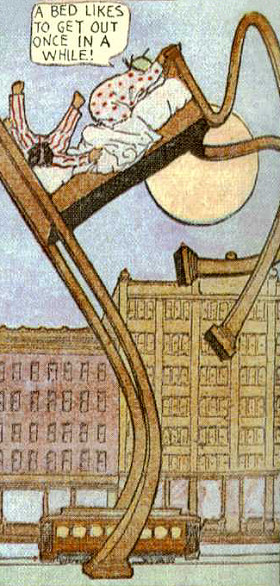
Winsor McCay was an influential artist who worked in comics and animation in the early 1900s.

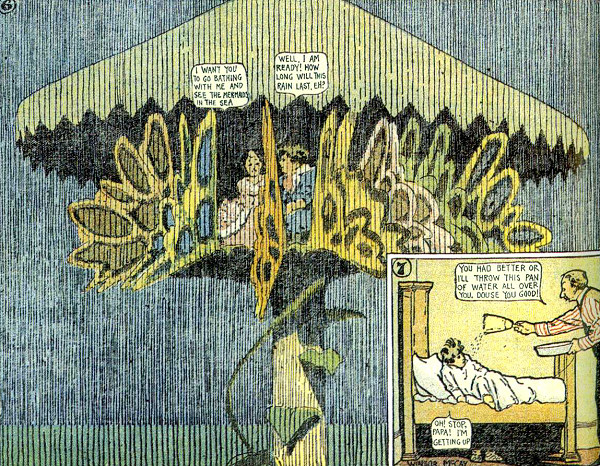
I first came across Little Nemo in Slumberland in “The Smithsonian Collection of Newspaper Comics,” a book that my grandmother gave me when I was young. It was some years later that I discovered Dream of the Rarebit Fiend. Both are creative comics involving dreams.

Here is a quote from McCay:

The principal factor in my success has been an absolute desire to draw constantly. I never decided to be an artist. Simply, I couldn’t stop myself from drawing. I drew for my own pleasure. I never wanted to know whether or not someone liked my drawings. I have never kept one of my drawings. I drew on walls, the school blackboard, odd bits of paper, the walls of barns. Today I’m still as fond of drawings as when I was a kid – and that was a long time ago – but, surprising as it may seem, I never thought about the money I would receive for my drawings. I simply drew them.

I would embed a few of my favorite Little Nemo comics here, but as they were intended for full newspaper pages, you really need to see them as large images. Fortunately, you can find nice collections on sites such as this one:

  • Little Nemo in Slumberland
  • Dream of the Rarebit Fiend
  •  
    Little Nemo: The Dream Master, which was based on McCay’s comic (or, more accurately, based on a Japanese animated film that was based on his comic) was one of my favorite games on the Nintendo Entertainment System. I couldn’t beat the final boss, though.


    Here is an example of Dream of the Rarebit Fiend:

    Unfortunately, collections of Little Nemo in Slumberland comics in book form tend to be expensive and to go out of print quickly. I own “Little Nemo: 1905-1914,” which was published in 2000 at a reasonable price–but it doesn’t seem to be so reasonable anymore. Dream of the Rarebit Fiend books are much cheaper and easier to find.

    McCay’s comics entered the public domain a few years ago, so they should remain easy enough to find in some form.

    There is also a nice book about his life and his art.


    Lasagna Cat

    Lasagna Cat is a series of (very) short films by a group called Fatal Farm. Each includes a live action enactment of a Garfield comic, followed by a music video featuring a well-known song.

    These are a few of my favorites, but they are all worth seeing.


    Some behind-the-scenes photos:


    Old French Synthesizer Music

    Over the past few years, I’ve come across several For some reason, I’ve come across a lot of very good French synthesizer music from the late 1970s and early 1980s, most of which seems to have only ever been released on vinyl. Fortunately, things that would be hopelessly obscure are often not difficult to find on the Internet.

    First and foremost,

    Roland Bocquet

    The two main albums to look out for are Robot Bleu and Robot Rose, each of which includes one of my two favorite songs of his (but by no means the only good ones), “Paradia” on Robot Rose and “La Suite D’Elsa” on Robot Bleu.

    Robot Bleu: Val Verde Music | Dance from Space
    Robot Rose: Mutant Sounds
    Paradia: Val Verde Music

    Next,

    Bernard Fevre

    I was already familiar with Black Devil Disco Club when I learned that Bernard Fevre had earlier created some very good non-disco synthesizer music. A good album to look for is The Strange World of Bernard Fevre, which has been re-issued as The Strange New World of Bernard Fevre. And a good sample song from that album is “Dali.”

    And if you like that album, you’ll probably also like Cosmos 2043.

    The Strange World of Bernard Fevre: Mutant Sounds
    Cosmos 2043: Funky Frolic

    From an interview with Fevre:

    I was drawn to the synthesiser because it enabled me to realize a symphonic vision that previously would have needed many musicians. With the synthesiser I could create the kind of sci-fi music you will hear on the “strange world of Bernard Fevre,” and then in the clubs it was the African rhythms that inspired me. I found that by mixing the primal beats with the electronic textures and melodies, it created a kind of “disco” sound. But for many people it was too new, too original, and they didn’t consider it disco at all.

    And finally,

    Garnegy & Maties

    I don’t know the story behind the albums Sport Music and Sport Music II. I’d guess that they might have been made to accompany television sports. Or maybe not. But I can tell you that they are very good, if you like this sort of thing.

    Sport Music Vol. 1: Funky Frolic | Plixid
    Sport Music Vol. 2: Funky Frolic | Plixid | The Growing Bin